Durham House
The Constant PrincessDurham House was the residence where Catalina of Aragon’s widowed years in England became a daily negotiation over money, status, and her future. The palace had gardens beside the River Thames, its own stairs and a pier for boats, yet its rooms also witnessed the material hardship and political uncertainty that followed the death of Arthur, Prince of Wales. Catalina’s time there sharpened her determination not to be treated as a temporary dependent who could simply be sent home.
Setting and arrival
After spending less than a month in seclusion at Croydon Palace, Catalina was told that Durham House had been prepared for her and that she could move there at her convenience. Her first response was to question whether the residence suited a Princess of Wales. She asked why she could not live again at Baynard’s Castle, and challenged the assurances of Dr. de Puebla, who said that her household had not been reduced and that the king would provide an allowance. Catalina’s question was more pointed than a matter of accommodation: she wanted to know whether the king would pay the jointure owed to his son’s widow.
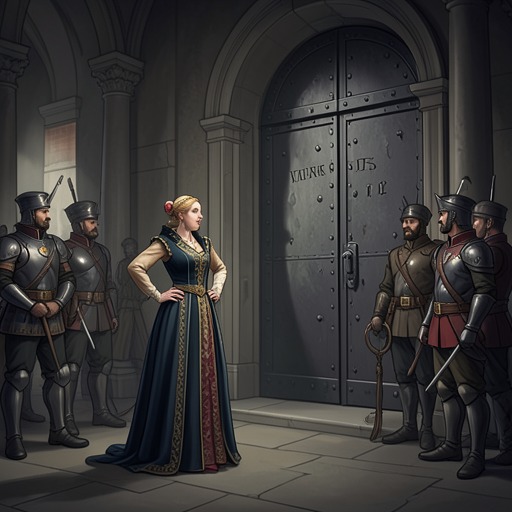
The small court moved to Durham House in late June 1502, while the remaining members of Catalina’s household arrived gradually from Ludlow Castle. They brought news of a silent town and a castle in mourning. Durham House itself was described as attractive, with gardens running down to the river and a private landing place. When Dr. de Puebla visited, Catalina was in the gallery at the front of the house, looking out over the courtyard and Ivy Lane. The contrast between the palace’s pleasant setting and the anxious business conducted within it would persist: the house offered a courtly residence, but not security.
Dowry, jointure, and the cost of widowhood
The financial conflict that followed Catalina to Durham House had begun before her move. At Ludlow Castle, she had described Henry VII as displeased over the dowry. Her father, Ferdinand of Aragon, had promised a substantial sum but sent only half in cash, suggesting that the value of her household goods and plate could make up the remainder. Henry demanded the full amount. Because Catalina’s household used her gold plates, their value diminished with every scrape of a knife; the arrangement made it harder for Ferdinand to count those goods as an untouched substitute for the money still owed.
At Durham House, the dispute became inseparable from the question of whether Catalina would stay in England. Her mother’s instructions treated her future as a set of financial contingencies. Catalina was to remain where she had been housed until she had completed her next course and knew whether she was pregnant. If she was not, Dr. de Puebla was to demand her jointure as Dowager Princess of Wales; only after the money had been paid in full was she to sail for Spain. If she was pregnant, the expected payment of the dowry was to be made in cash, her allowance secured, and she was to rest in hope of a boy. The letter’s terms left little room for maternal comfort: Catalina’s residence, income, and journey were all tied to the anticipated child and the settlement of accounts.
Catalina understood that the English king might prefer to keep both her and the money in his hands. Her jointure was defined as a third of the revenues of Wales, Cornwall, and Chester, payable until she remarried. Her parents also sought the return of her entire dowry. She doubted that Henry would pay these sums, recalling that he had not even paid her allowance while Arthur was alive. The contract gave her a claim, but not the means to make the king honor it. In her view, the financial deadlock made her vulnerable: without the unpaid dowry, she could not compel the English to carry through the betrothal to Prince Henry, while Henry’s hostility left her powerless to force a settlement.
A residence under pressure
When Catalina had been at Durham House for only a short time, the king’s chamberlain announced that the household could move there from Croydon. Later, after a period of mourning, Catalina received Dr. de Puebla in her private chamber and challenged the status of the new residence. His description of it as adequate, with a court and an allowance, did not resolve her concern about the widow’s jointure. She was not merely asking whether the rooms were comfortable. She was testing whether the king would recognize her standing as the prince’s widow and meet the obligations attached to it.
In June 1502, Dr. de Puebla told Catalina that her mother was preparing to send an emissary to escort her home once the jointure had been paid. Since Catalina had not said that she was pregnant, her parents were planning for her return. She responded by asking how much Henry owed her. When she learned that her parents wanted the dowry returned as well as the revenues due to her, she judged that the king would never pay. Her composure nearly broke when Dr. de Puebla suggested that her parents might already have arranged another marriage. She turned to look through the open gates toward the street rather than answer at once.
The view from Durham House made the prospect of return vivid. Catalina remembered the warmer, more familiar world she had left: its veiled women, flower and spice sellers, physicians, herbalists, astronomers, mosques, and fountains. Outside the house lay a different city, busy with commerce and church bells, prosperous and self-confident. Yet the contrast did not persuade her that England was merely a place of exile. She resolved that it was her home now and insisted that her parents could not simply redirect the life for which she had been raised. She would not be cast off as a bad debt.
Poverty, friendship, and political isolation
Durham House did not shelter Catalina from the consequences of the stalled negotiations. When Margaret Pole visited late in the evening, she found Catalina in a shabby room. The visitor noticed the condition of the house, while Catalina explained that she had little money beyond the king’s inadequate allowance and that Doña Elvira was of little help. The other chambers had no fires burning, and the presence of a visitor was unusual in the quiet household. The palace’s gardens and river access could not disguise how restricted Catalina’s means had become.
The two women spoke frankly about the unresolved dowry and Catalina’s possible return. Catalina said that the king was holding both her and her dowry while her parents allowed the situation to continue. Margaret had heard that Catalina might be betrothed to Prince Henry, but Catalina observed that what seemed an obvious solution did not appear obvious to the king. Their friendship offered a rare space in which she could discuss her predicament, but it could not itself end the political stalemate.
The same isolation shaped a later visit from Henry VII. After staying away for a month out of decency, he came formally to Durham House. His attention settled on the worn curtains, rugs, and hangings; he believed Catalina should welcome a resolution and considered her dependent on his power, with her parents unable to free her. The state of the furnishings was thus more than a sign of hardship: it showed how long she had been left without the resources to maintain her household, while making visible the imbalance between king and daughter-in-law.
From waiting to authority
Catalina’s years at Durham House formed part of a longer wait for the marriage to Prince Henry to become a reality. She later described turning the panels of her gowns and selling her jewels to buy food. She also sold her precious plate piece by piece, knowing that it belonged to the king and that each sale would postpone the wedding further. But the household had to eat, and she could neither pay her servants’ wages nor expect them to go hungry. The delay was not an abstract political inconvenience; it pressed on the contents of her wardrobe and plate chest, and on the people who depended on her.
That experience later became part of the practical knowledge she brought to queenship. As queen, Catalina remembered trying to run Durham House as a royal palace with no income. She knew the cost of bread, the difference between salted and fresh fish, and the relative prices of Spanish and French wine. Her close scrutiny of the royal household accounts grew out of hard experience of scarcity, not simply an interest in ceremony or display. At court she regularly examined departmental expenditure and used her knowledge to press for better prices.
Durham House also stands in contrast to the position Catalina later claimed in England. As queen, she summoned Margaret Pole to her court and could repay María de Salinas the wages owed to her. She consulted advisers and worked with members of the Privy Council on law, coastal defenses, ships, and army musters. Later still, Henry VIII invested her as regent, governor of the realm, and captain general for home defense before sailing from Dover. Durham House was not the seat from which she exercised those powers, but the hardship and uncertainty she endured there help explain the material competence and resolve she later brought to government. In the narrative, the palace is both a stage of confinement and a training ground: a place where the claims of royal status met the realities of unpaid obligations, and where Catalina began to insist that her future in England could not be settled by others alone.